Wellness
A closer look at tulåh’s approach to wellness
The retreat designed to become part of how you live
We've noticed a growing number of travellers choosing their destination based not on where they want to go, but on how they want to feel when they return, whether that's improving their health, learning something new or returning home a different version of themselves.
Few places take that idea as far as tulåh. Set against the Western Ghats in Kerala, India, its highly personalised approach draws on modern medicine, advanced diagnostics, Ayurveda, nutrition, movement and more, with the aim of creating changes that last well beyond your time there. This isn’t simply somewhere you go to feel better for a week. What you learn is designed to travel home with you and become part of how you live.
It’s an approach unlike anything we’ve come across before, so naturally, we wanted to know more. We spoke to Ciara O’Shea, Chief Commercial Officer at tulåh, about what really happens during a stay, the thinking behind it and why the experience doesn’t end when you check out.
tulåh is rooted in Kerala. What is it about this particular landscape that makes it such a powerful setting for healing?

Kerala has been giving healing to the world for thousands of years. Ayurveda has been practised here for millennia, and for just as long, Kerala's spices, herbs and medicinal ingredients travelled the world through trade. That instinct is still in the culture. Kerala is known around the world for its doctors and nurses. Care is part of who people are here.
Then there is the land. tulåh sits against the Western Ghats, one of the most biodiverse regions on earth. When we began, much of our 30 acres was barren laterite rock. Today it is a living tropical ecosystem. Our herbal garden holds more than 215 species traced back to the Hortus Malabaricus, the record of this region's medicinal plants first published in 1678, and our Ayurveda doctors still use them today.
So the first tulåh could only have been here. Kerala has shared healing with the world for generations. We are continuing that, in a contemporary way.
What does it mean to you that tulåh describes itself as "a philosophy and a blueprint for life" rather than simply a destination?
It means the real work begins when you go home. We can tell you what is happening in your body and build a protocol around it. But if nothing changes when you leave, what was the point?
So every guest leaves with a personalised plan covering nutrition, movement, mental wellbeing and lifestyle, carried forward through the tulåh app. Our team stays with you for three months, and your Life Index results become the reference point you measure yourself against. We believe that a destination is somewhere you visit, a blueprint is something you take with you.
Every journey at tulåh is personalised. How does that process work from before a guest arrives through to their time at the sanctuary?

It starts well before you arrive. Every guest begins with a consultation with one of our doctors, so we understand what they are looking for and what we may need to investigate. Genome and microbiome testing is done in advance, so that layer of information is ready before you arrive at tulåh.
Your first two days are dedicated to assessment, across all tiers. This includes advanced blood profiling across metabolic, hormonal, inflammatory and cardiovascular markers, including biological age; diagnostics and imaging where indicated, from MRI and coronary calcium scoring to DEXA; and performance testing, including VO2 max, body composition, strength and mobility.
After we have all the results, our Multidisciplinary Clinical Wellness Council reviews everything together, with modern medicine, Ayurveda, functional medicine, genomics, clinical psychology, nutrition and movement science at the same table. Your programme is built from what we find. Only then does the journey really begin.
Can you walk us through what a typical day at tulåh might look like?

There is no typical day, because every programme is different. But there is a tulåh rhythm. Mornings begin with morning rituals (for example, a breathing ritual to wake up your body or laughing yoga) followed by movement (from cycling and running to tennis, padel, pickleball, active yoga sessions or our aquatic sports), then guests depart for breakfast, followed by group sessions or one-on-one consultations or individual therapies. There may be a session in the Sonorium before lunch. The afternoon brings more consultations, treatments or movement, depending on your programme, and many guests walk through the Enchanted Forest or the herbal garden in between or join Vedanta classes. Some days close with an evening session and Sufi music.
And there is always time to rest. Your body needs space to process what you are asking of it, so we leave room in the day on purpose. The rhythm between assessment, intervention, movement, nourishment and rest matters as much as any single treatment.
tulåh brings modern medicine together with traditions including Ayurveda and yoga. How do those different disciplines work alongside one another when creating a guest's programme?

Every journey opens with modern medicine. Our physicians lead the diagnosis, monitor you throughout your stay and keep you safe, with acute care available whenever it is needed. Their findings are the evidence the rest of the team builds on.
From there, each discipline reads you through its own lens. Ayurveda looks for imbalance at the root. Functional medicine traces the drivers behind chronic concerns. Your genome adds its own insight. Nutrition, physiotherapy and sports science work on metabolic health and physical capacity. Clinical psychology and Vedanta work with the mind, and yoga and sound work at the level of energy.
What matters is that they work as one team, looking at the same person and sharing what they see. You never have to choose between modern medicine and traditional wisdom. We bring them together and build one plan around you.
What is the tulåh Life Index and what does it tell a guest about themselves that they might not already know?
Most people only ever see their health in fragments: a blood test here, a scan there, a sense of how they feel when they wake up. The tulåh Life Index is our proprietary framework for bringing all of it into one picture. It measures seven dimensions together: cardiovascular health, muscle health, immune health and inflammation, gut health, lifestyle risk, quality of life and stress management. And it rests on the full depth of diagnostics we carry out before and during your stay, far beyond any questionnaire.
The insight comes from seeing them side by side. You may feel well and discover areas that need attention. Or you arrive not feeling your best and finally understand why. Above all, it gives you a baseline: where you stand on arrival, how far you have moved by the time you leave, and what to keep working on at home.
Clinical Yoga at tulåh takes yoga into a therapeutic and rehabilitative setting. What makes this different from a conventional yoga practice?

We treat yoga as a clinical discipline. Conventional classes are designed for a group. Clinical yoga starts with the individual and with what we are trying to address. Each posture is prescribed, aligned and refined with the same precision we bring to any medical intervention.
Practice is guided one posture at a time, supported where needed by props custom-made for tulåh, so bodies of almost any age or condition can find correct alignment safely. The corrections are subtle, but they are felt throughout the body. As alignment improves, the tension and holding patterns that drain energy begin to release. And it is part of the same integrated plan as the medical work, helping the results of everything else last.
The Sonorium sounds extraordinary. Can you tell us more about what guests actually experience there?

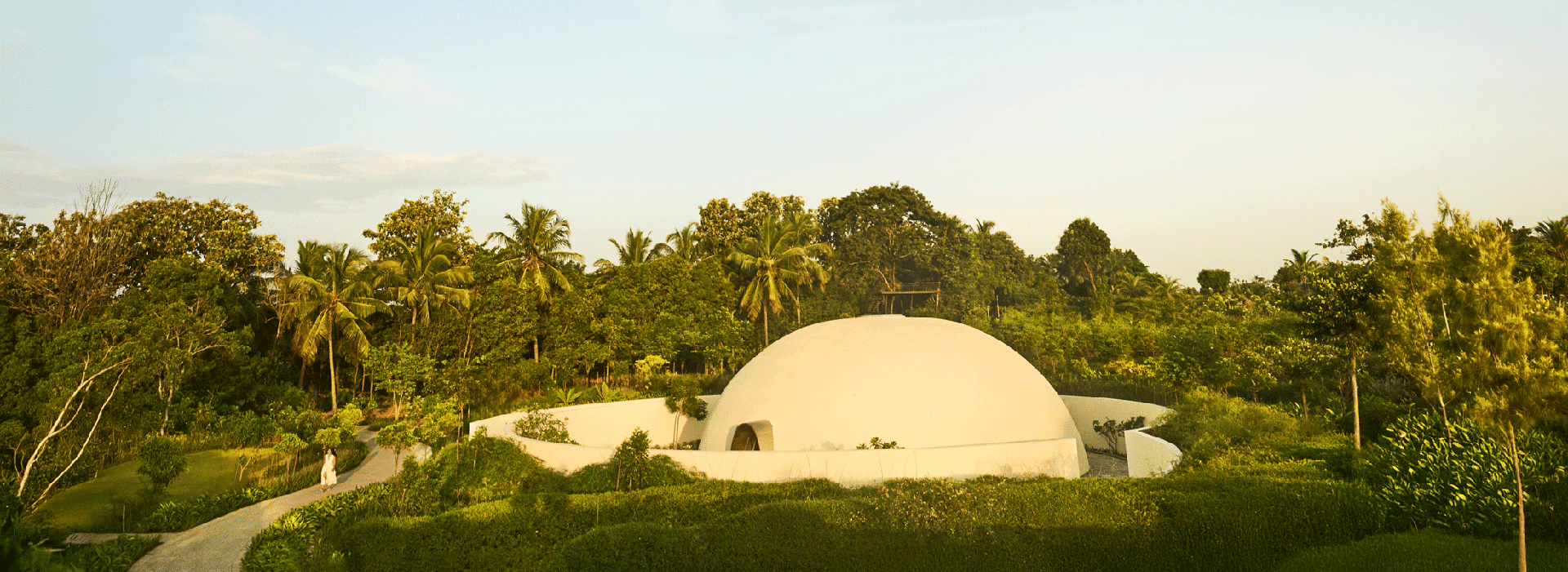
The Sonorium is the world's largest sound healing dome, and it is very different from what most people imagine sound healing to be. It was inaugurated by A.R. Rahman, which felt fitting for a space built entirely around sound. The building itself is an instrument. It is a seven-petalled dome, each petal reflecting one of the seven chakras, with no sharp corners anywhere. At its centre is the Nidranantar, a still point of deep repose, surrounded by a circle of large instruments developed with SVARAM in Auroville, each tuned to Just Intonation across 64 to 1024 Hz.
Guests lie on vibro-acoustic beds, so the sound is felt through the body as well as heard. It is designed to draw the nervous system out of fight or flight and into a state of deep relaxation and inner awareness. Our principle is simple: to repair anything, you must first reset it. The Sonorium is where that reset happens.
What would you say to a guest who is considering tulåh but is unsure whether a clinical wellness retreat is right for them?
We would ask them one question: when did you last see your whole health in one place? Most people who hesitate assume "clinical" means you have to be unwell, or that it will feel like a hospital. Neither is true. Many of our guests arrive feeling perfectly well. They come because feeling well and being well are not the same thing. The conditions that shape how we age, from heart disease to metabolic decline, build quietly for years before you feel anything. By the time you do, you are treating them rather than preventing them.
And tulåh does not feel clinical. You spend your days in nature, not a waiting room. The medicine works quietly in the background, so you can rest while it is done. A beautiful retreat will help you feel better for a few weeks. We want you to leave knowing exactly where you stand and what to change, with a team behind you for the months that follow. That is a very different return on your time.
If you are still unsure, speak to one of our doctors before you decide. The consultation is complimentary, and one conversation will tell you whether tulåh is right for you.
What do guests most commonly say has surprised them about their time at tulåh?

The first thing is the place itself. People see the photographs and think it can't really look like that. Then they arrive and say, "This is actually real." What surprises them more is learning that almost none of it existed. The forest they walk through was once barren laterite rock. The 23-metre waterfall is part of an engineered rainforest habitat. Even the silence of their rooms is by design, cooled through the ceiling rather than by forced air.
The other surprise is Vedanta, the ancient Indian philosophy of self-knowledge. Guests expect the clinical side to be the most transformative part of their stay. Then they tell us the Vedanta sessions are what they keep thinking about long after they leave. People come for different reasons and leave with something they didn't expect: a clinical discovery, a conversation, a moment in the Sonorium, something they learn about themselves. You don't always know what will stay with you until you leave.
Few trips have the potential to change the way you think about your health quite like a stay at tulåh. Book through Little Emperors and your stay includes early check-in and late check-out, full board throughout and a sanctuary credit towards additional treatments. Find out more and book your tulåh stay here.